Where the time goes
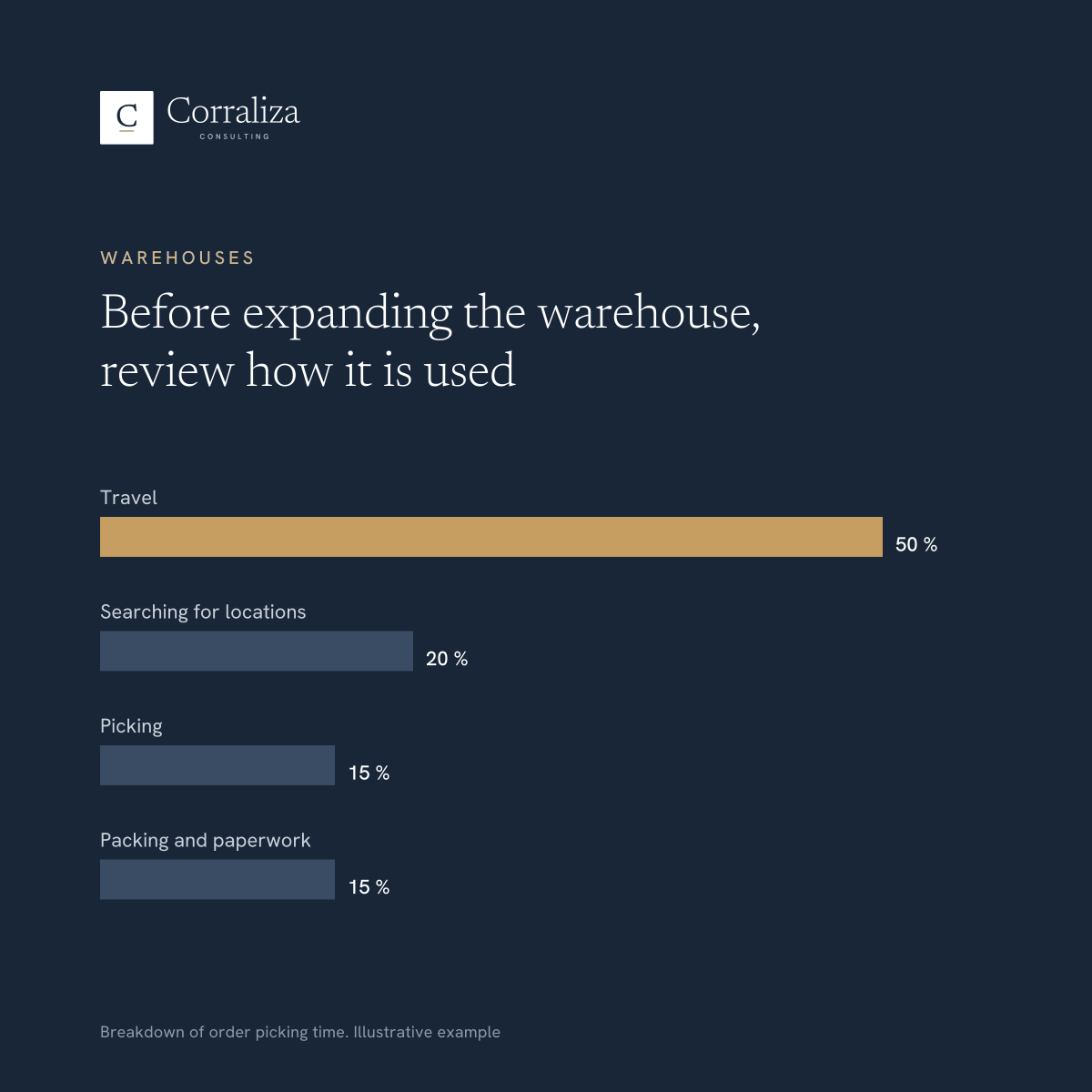
In order picking, most of the time is not spent taking the product. In the illustrative example in the chart:
- Travel around the warehouse: 50%.
- Searching for locations and checks: 20%.
- Picking the product: 15%.
- Packing and paperwork: 15%.
Only 15% of the time adds direct value. The rest depends on how the warehouse is organised: where each product is located, how orders are grouped and what information the picker has.
Signs that the problem is organisation
- Fast-moving products are far from the dispatch area or at heights that are hard to reach.
- Aisles are taken up by slow-moving or obsolete stock.
- Each operator picks orders one at a time, covering the whole warehouse for each one.
- Locations are not labelled, or the system does not show where goods actually are.
- Occupancy is high, but a significant part of the inventory has not moved for months.
What can be improved without expanding
- Slotting by turnover: placing the best-selling products close to dispatch and at a comfortable height. This is usually the measure with the greatest effect on travel.
- Batch picking: picking several orders in a single route when they share products or area.
- Inventory review: removing or clearing obsolete stock frees up space in the best locations.
- Reliable information: labelled locations recorded in the system reduce search time and errors.
- Measurement: lines picked per hour and errors per thousand lines show the effect of each change.
A worked example
A warehouse with 10 pickers spends half of their time travelling. If re-slotting products by turnover cuts travel by a third, each picker gains just over 15% of their working day. The same team can pick more orders or absorb expected growth without hiring. The investment required is limited to the re-slotting work and, where necessary, adjustments to the warehouse management system.
When expansion is justified
If, after reorganising the warehouse, occupancy remains close to the maximum and expected volume is growing, an expansion or a new warehouse may be justified. In that case, the prior analysis also helps to size the investment correctly and design the new layout from the start.