In many companies transport is controlled by the monthly total: if the invoice goes up, the rate is renegotiated or the carrier is changed. However, the factor with the greatest influence on cost is usually not the rate, but the way goods are shipped.
Shipment size changes everything
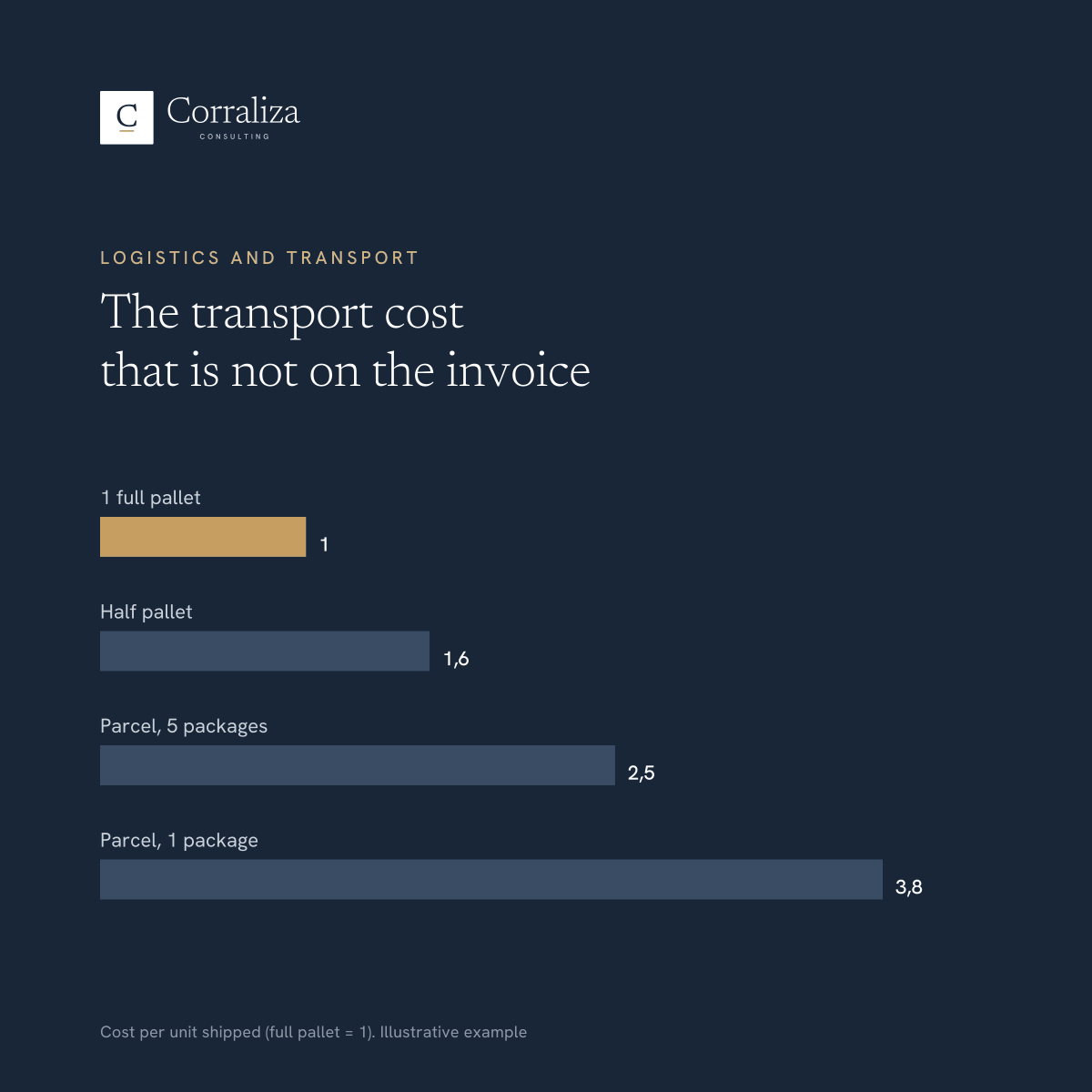
The chart shows an illustrative example of the cost per unit shipped, using a full pallet as the reference:
- Full pallet: 1.
- Half pallet: 1.6 times more per unit.
- Parcel with 5 packages: 2.5 times more.
- Parcel with 1 package: 3.8 times more.
The same goods can cost almost four times more per unit if they are shipped in small consignments. The fixed cost of each shipment (collection, handling, paperwork and delivery) is spread over fewer units.
An example
A company sends 40 orders a week to the same area. If each order is shipped separately by parcel carrier, it pays for 40 shipments. If it groups them into two delivery days and consolidates the goods on pallets, the number of shipments falls to a handful and the cost per unit approaches that of a full pallet. The customer receives the same goods, with a difference of one or two days that often does not affect them.
Why it happens
Small shipments do not always reflect a customer need. They are often the result of internal decisions:
- Orders shipped as soon as they arrive, without consolidating them by customer or area.
- No minimum order size or freight policy that encourages larger orders.
- Partial shipments due to stock-outs, which require a second shipment to complete the order.
- Urgent deliveries that could be avoided with better sales or production planning.
How to measure it
To know the real cost, you need to move from the total invoice to the cost per shipment, per customer and per unit shipped. With the carrier’s data and the order system you can calculate:
- The number of shipments and their average size per customer.
- The cost per unit by type of shipment.
- How much of the spend relates to partial or urgent shipments.
- Which customers generate a transport cost out of proportion to their margin.
What can be done
The most common measures require no investment: consolidating orders by delivery day, setting minimum orders or charging freight below a certain amount, improving stock availability to avoid partial shipments and reviewing rates by type of shipment with carriers. Before negotiating prices, it is worth organising shipments, because the savings are usually greater.
These measures should be agreed with the sales team. A minimum order or a fixed delivery day is easier for customers to accept if it is presented as part of a better service: predictable deliveries, complete orders and fewer incidents.