The example
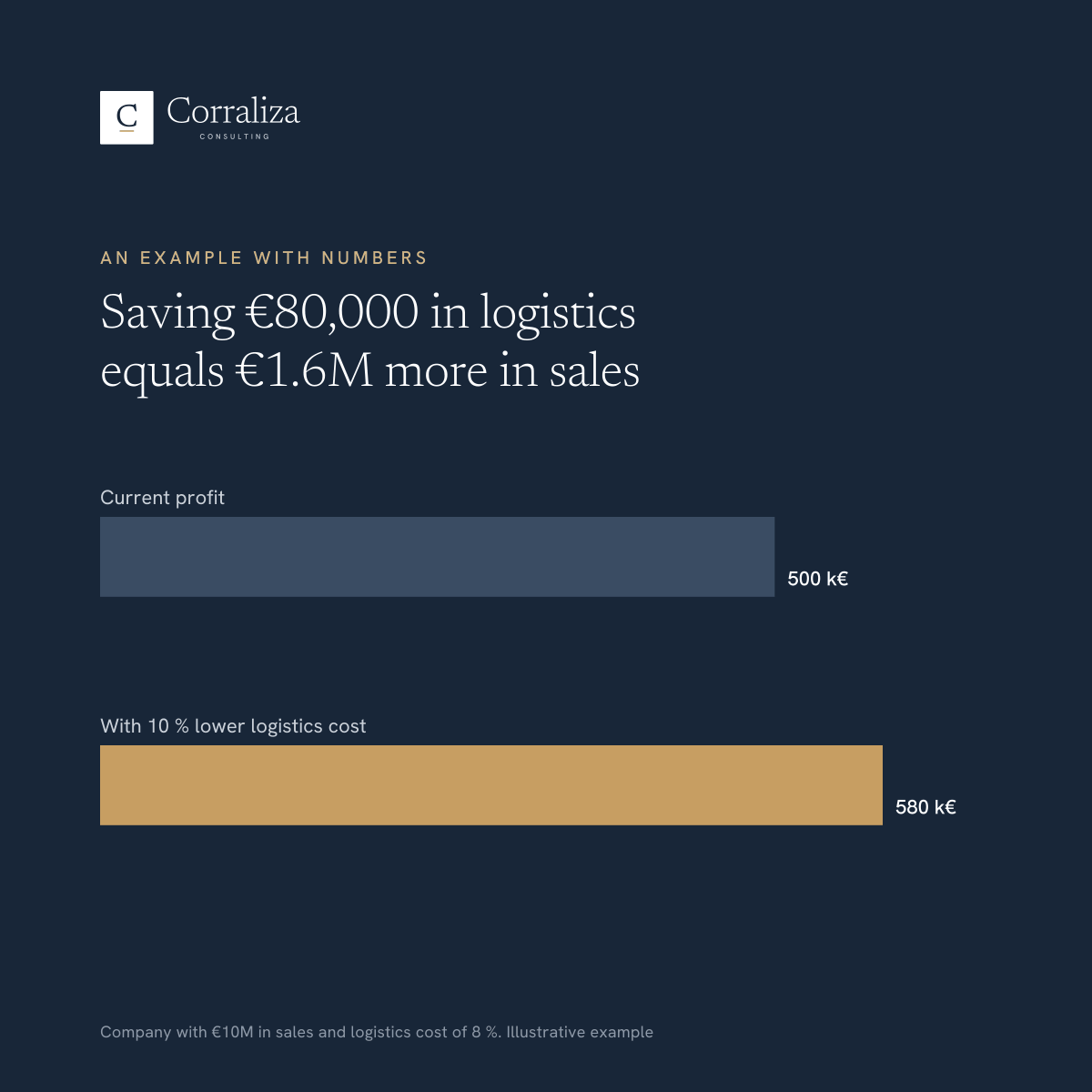
A company has annual sales of €10 million and a profit of €500,000, 5% of sales. Its logistics cost, including warehouses, transport and staff, amounts to 8% of sales: €800,000.
If that cost is reduced by 10%, the saving is €80,000 and profit rises from €500,000 to €580,000.
How much would you need to sell to earn the same?
With a 5% margin on sales, each additional euro of turnover leaves 5 cents of profit. To earn €80,000 more, the company would need €1.6 million in additional sales, 16% more.
The calculation is simplified: part of the costs are fixed and the margin on additional sales may be somewhat higher. Even so, the difference in effort is clear. Growing by 16% requires new customers, more capacity and often commercial investment. Reducing logistics cost by 10% depends mainly on internal decisions.
What to include in logistics cost
For the comparison to be correct, logistics cost must include everything it costs to move and store goods, not just the carrier’s invoice:
- Inbound transport from suppliers and outbound transport to customers, including urgent shipments and returns.
- Warehousing: rent or depreciation of the building, handling equipment, energy, maintenance and insurance.
- Warehouse and dispatch staff, including overtime and temporary labour.
- Financial cost of inventory and losses from obsolescence, damage or expiry.
- Warehouse and transport management systems.
When all these items are added up, logistics cost is usually higher than estimated. In many manufacturing and distribution companies it ranges from 5% to 12% of sales, depending on the sector and type of customer.
Where the savings usually are
- Transport: split shipments that could be consolidated, rates that have not been reviewed or poorly used routes.
- Warehouse: long picking routes, locations that do not reflect product turnover or poorly used space.
- Inventory: stock above what is needed, with its financial and space cost.
- Staff: workload peaks covered with overtime because of a lack of planning.
How to start
The first step is to know the full logistics cost, broken down by activity, customer or channel. Many companies have not calculated it, because it is spread across different accounts. With that information, improvements can be prioritised by financial impact and the result of each one can be measured.
Monitoring is as important as the initial analysis. Indicators such as logistics cost as a percentage of sales, cost per order delivered or cost per pallet stored make it possible to check month by month that savings are sustained and to detect any deviation in time.